When choosing an NVMe SSD, the presence of DRAM is a crucial factor influencing performance. With DRAM, FTL mapping information can be quickly referenced, significantly improving random performance and responsiveness.
To serve as a PS5 expansion storage, a sequential read speed of 5,500MB/s or higher is essential. The ADATA LEGEND 960, with speeds up to 7,400MB/s and integrated DRAM, delivers stable performance on both PC and PS5.
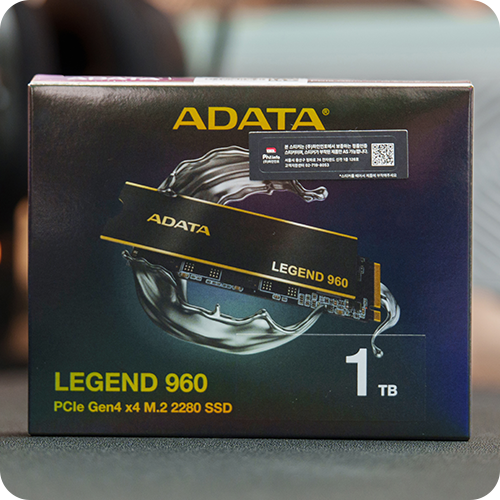
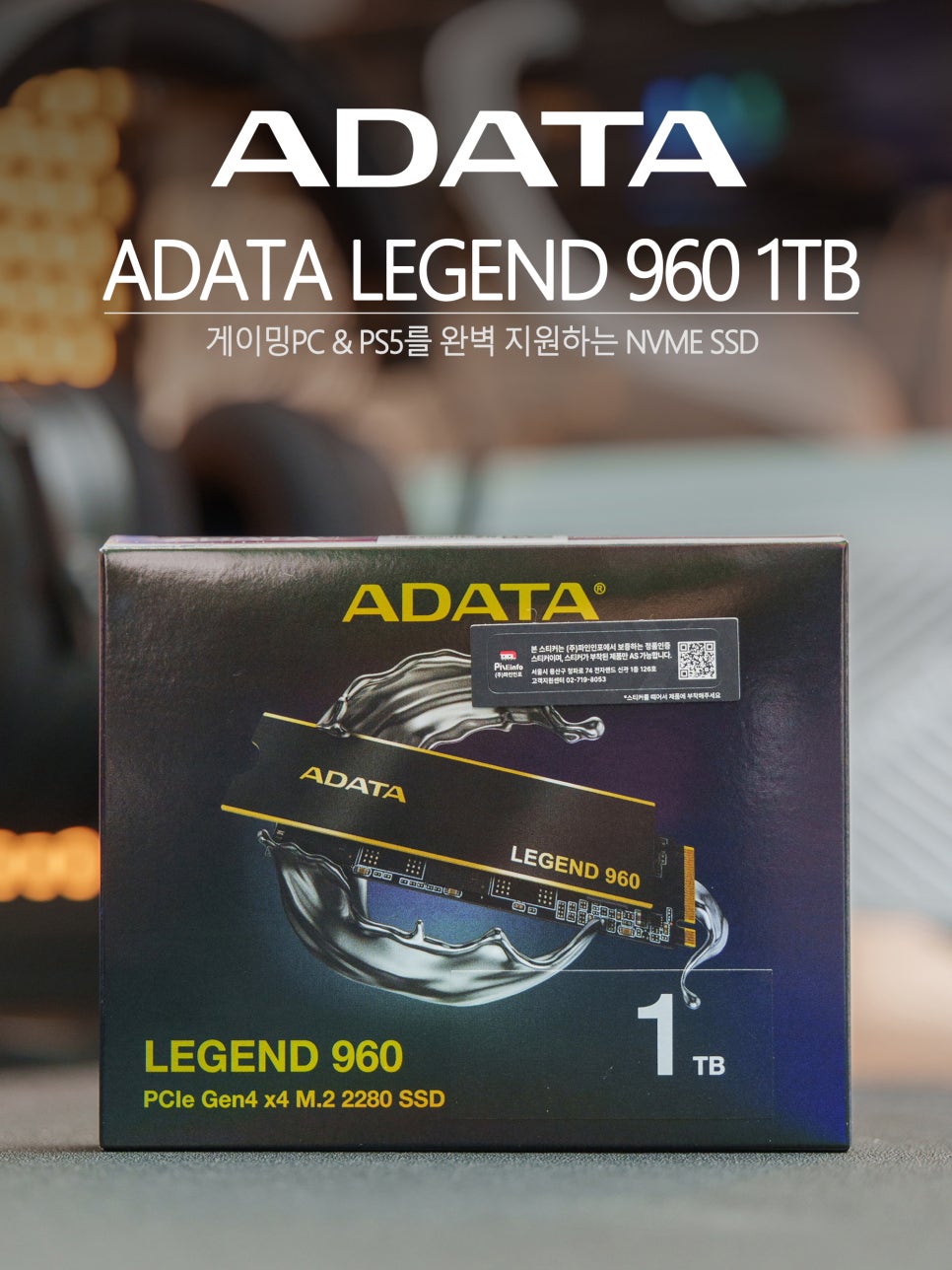
The recently released ADATA LEGEND 960 is a model that offers a maximum sequential read speed of 7,400MB/s while also incorporating ample DRAM, ensuring real-world stability. This product, an authentic FineInfo import supporting 4 years of after-sales service, is what we will now examine in detail: the ADATA LEGEND 960 M.2 NVMe FineInfo 1TB model.
Specifications and Configuration
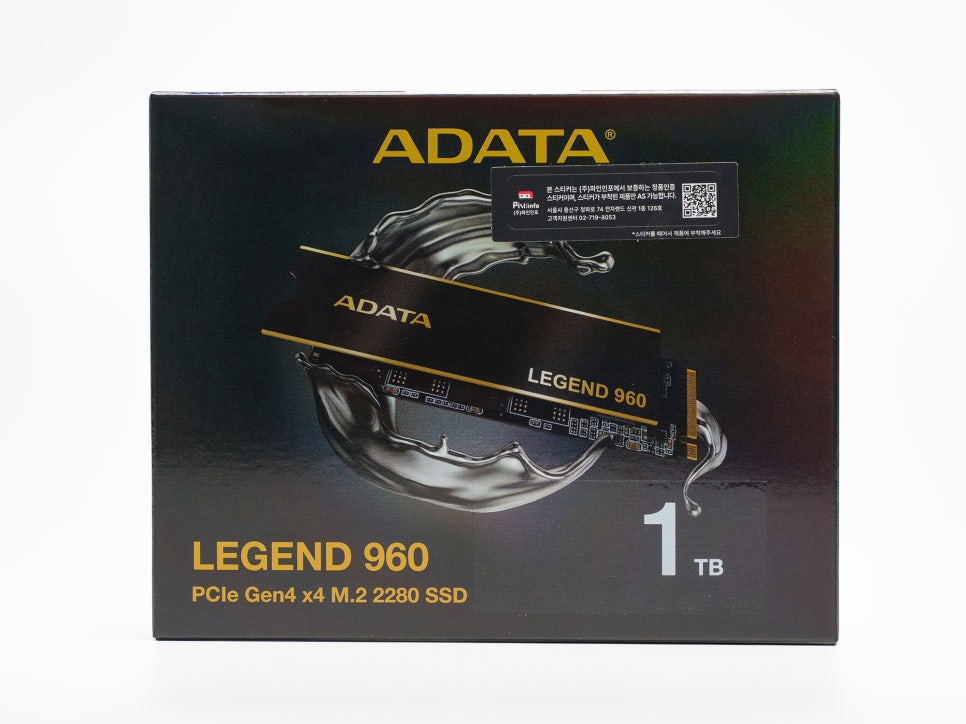
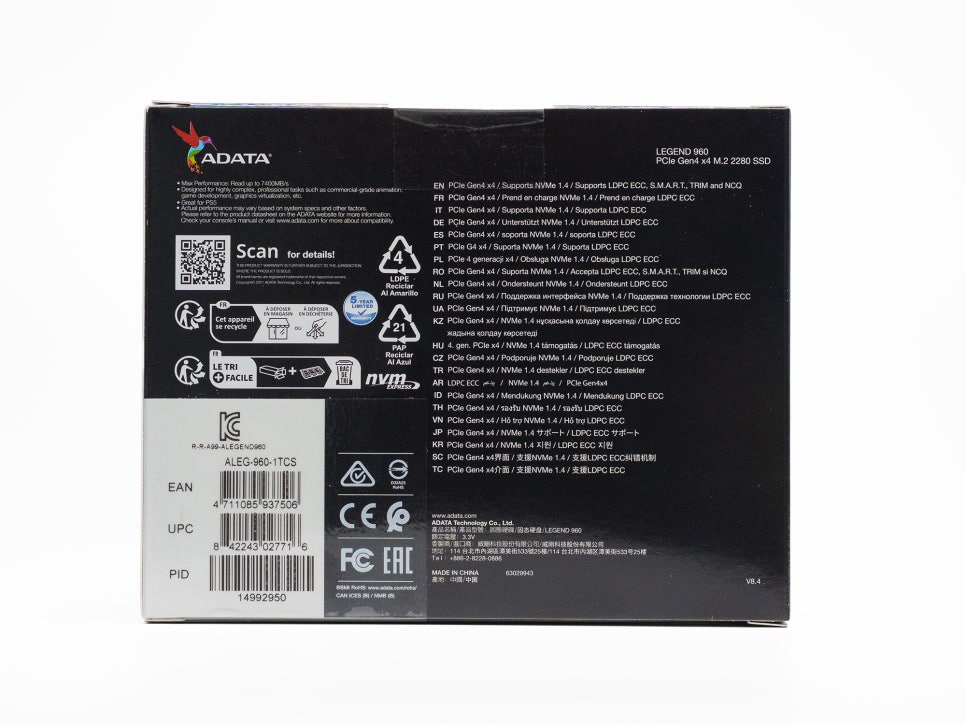
The interface supports the NVMe 1.4 protocol based on PCIe Gen4 x4, and the form factor is the standard M.2 2280. It supports sequential read speeds up to 7,400MB/s and sequential write speeds up to 6,400MB/s. 4K random read is listed as up to 730K IOPS, and random write as up to 610K IOPS in the specifications. It is equipped with a Silicon Motion SM2264 controller, Micron 176-layer 3D TLC NAND flash (B47R), and Samsung DDR4 1GB DRAM (for the 1TB model).
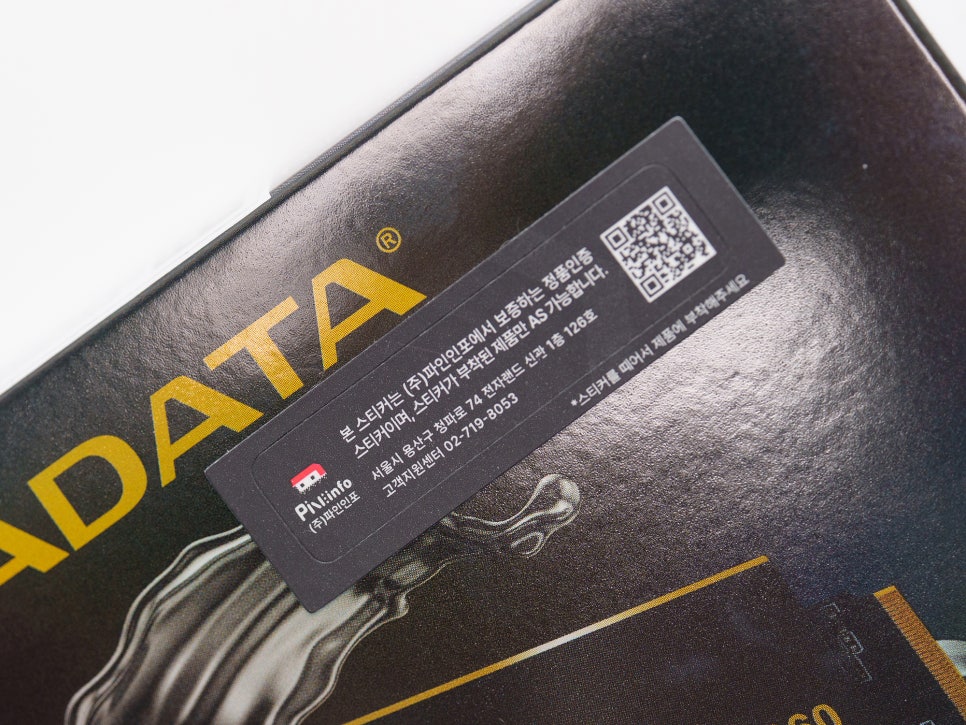
A 5-year limited warranty service is provided for product defects, and in Korea, authentic after-sales service (AS) is available through the official distributor Fine Info, making post-purchase management easy.
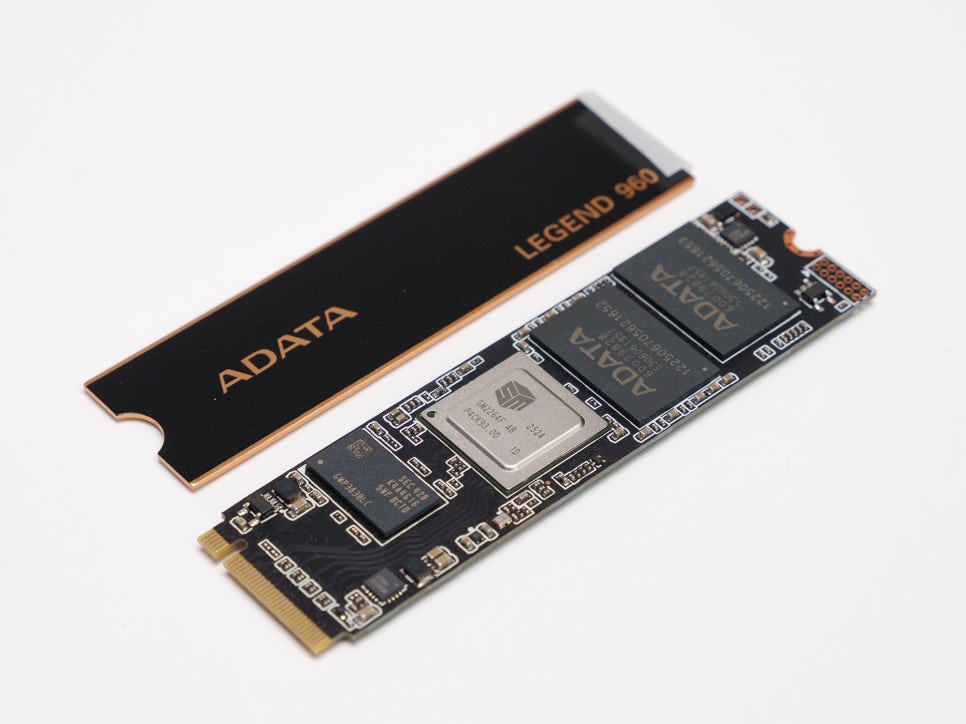
Upon opening the package, you’ll find the LEGEND 960 SSD unit along with a separate aluminum heatsink. The heatsink features a sophisticated black surface finish, offering a sleek look while effectively dissipating heat. Users can easily attach it to the controller side using double-sided tape. Even with the heatsink installed, the total thickness is merely 4.68mm, ensuring stable installation and operation in the PS5’s internal M.2 slot without any interference.
Appearance and Features
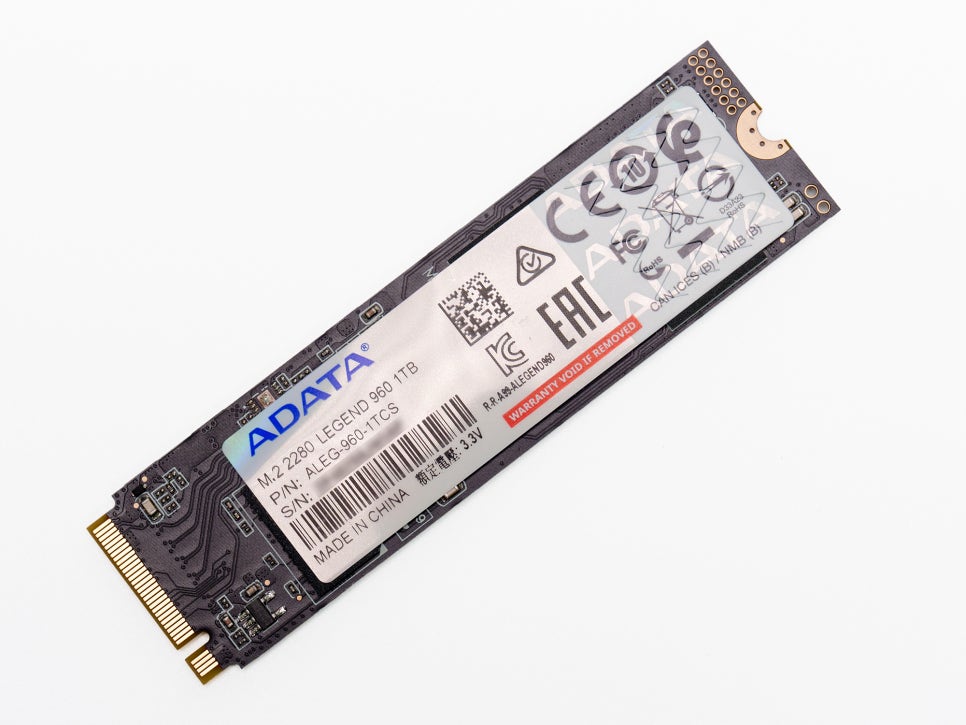
The ADATA LEGEND 960 adopts the M.2 2280 form factor. With a standard size of 22mm width and 80mm length, it is compatible with most desktop motherboards, laptops, and the PS5’s expansion slot currently available on the market. It is released with three capacity options—1TB, 2TB, and 4TB—allowing you to choose according to your intended use.
The interface is based on PCIe Gen4 x4 NVMe 1.4, providing sequential read speeds of up to 7,400MB/s and sequential write speeds of up to 6,400MB/s for the 1TB model. For the 2TB and 4TB models, sequential write speeds increase to 6,800MB/s.
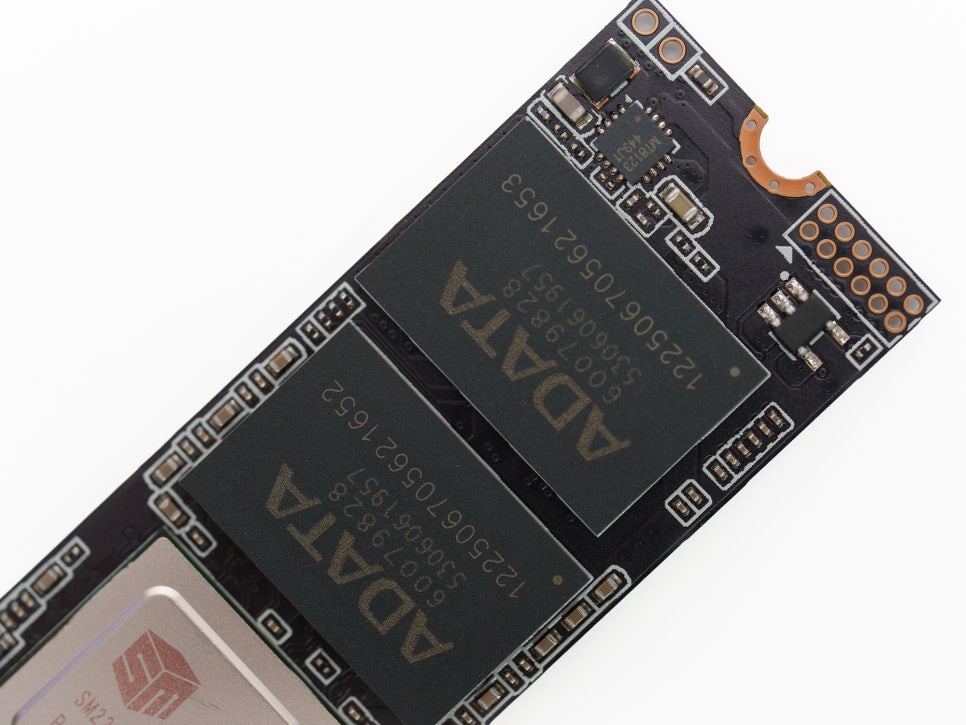
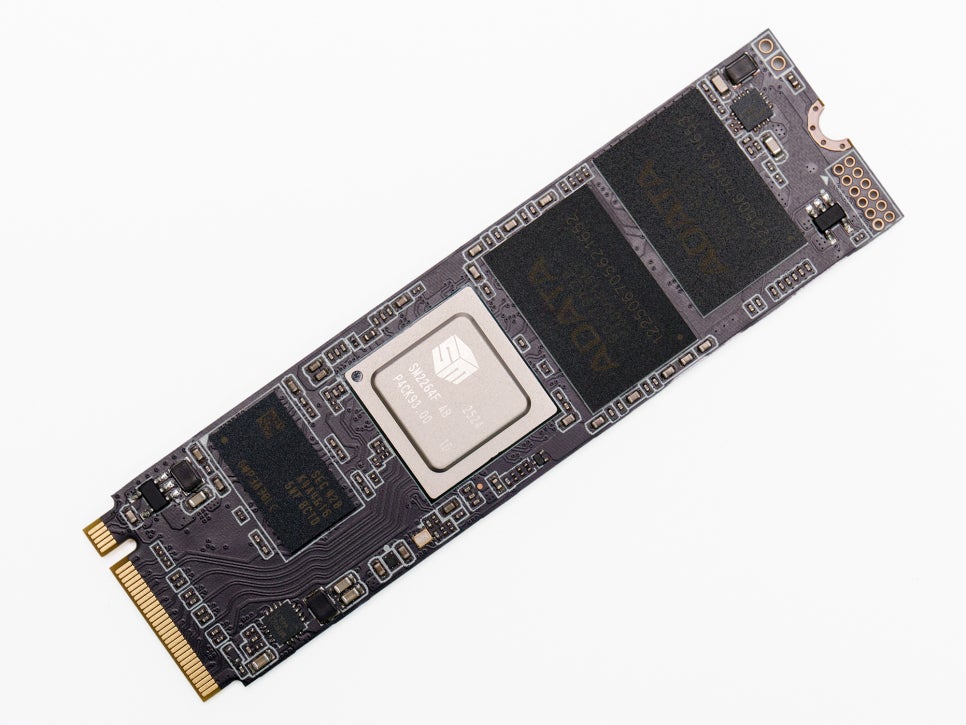
Looking at the NAND configuration, it uses Micron B47R 176-layer 3D TLC NAND. The 1TB model features four 256GB NAND packages, with two placed on each side of the PCB.
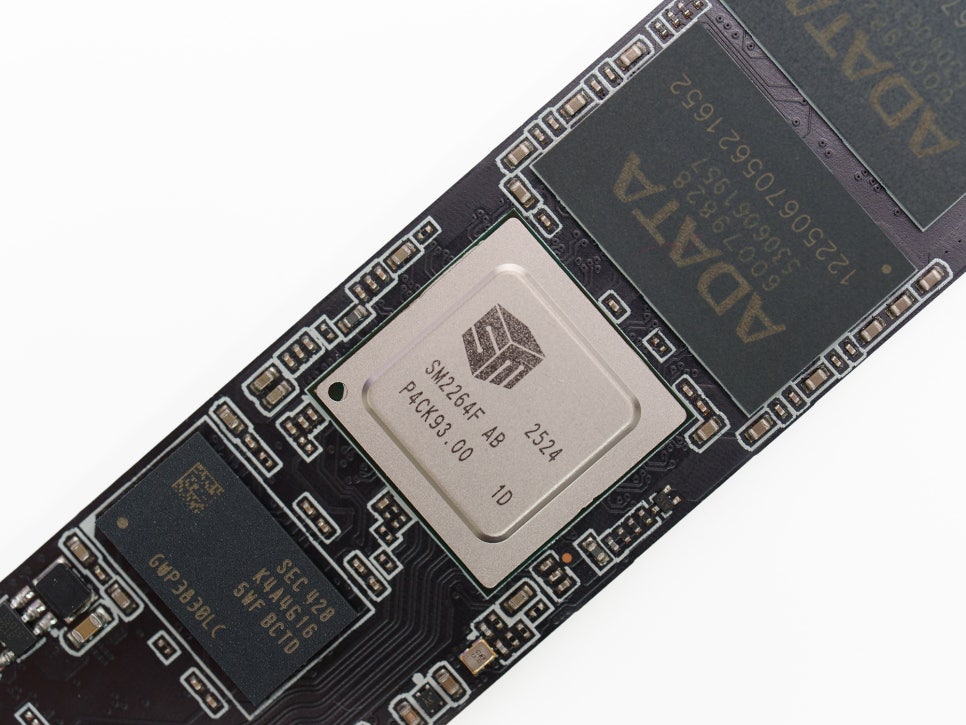
The controller used is Silicon Motion’s SM2264F, a high-end chip manufactured using a 12nm process, featuring a quad-core ARM Cortex-R8 CPU. It boasts 4KB codeword-based LDPC error correction technology, AES 256-bit hardware encryption, and end-to-end data path protection. A key feature is its doubled ECC codeword size compared to the previous generation SM2262EN, significantly enhancing data integrity.
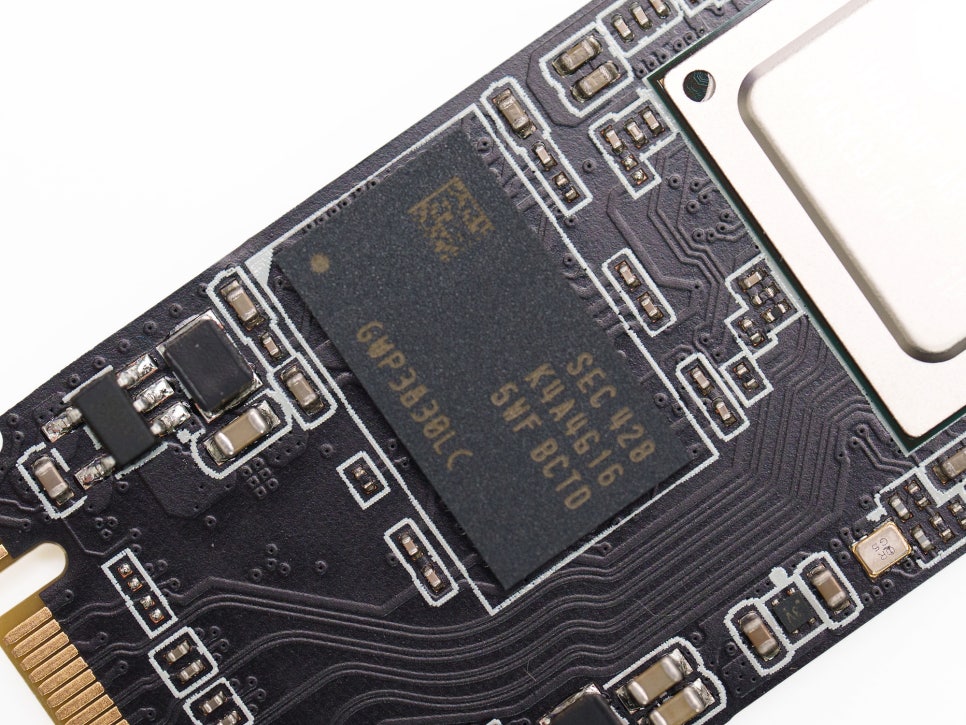
For DRAM, two Samsung DDR4 modules are installed, one on each side, providing a total cache capacity of 1GB for the 1TB model. This, combined with SLC caching technology, minimizes performance degradation even when processing large amounts of data.

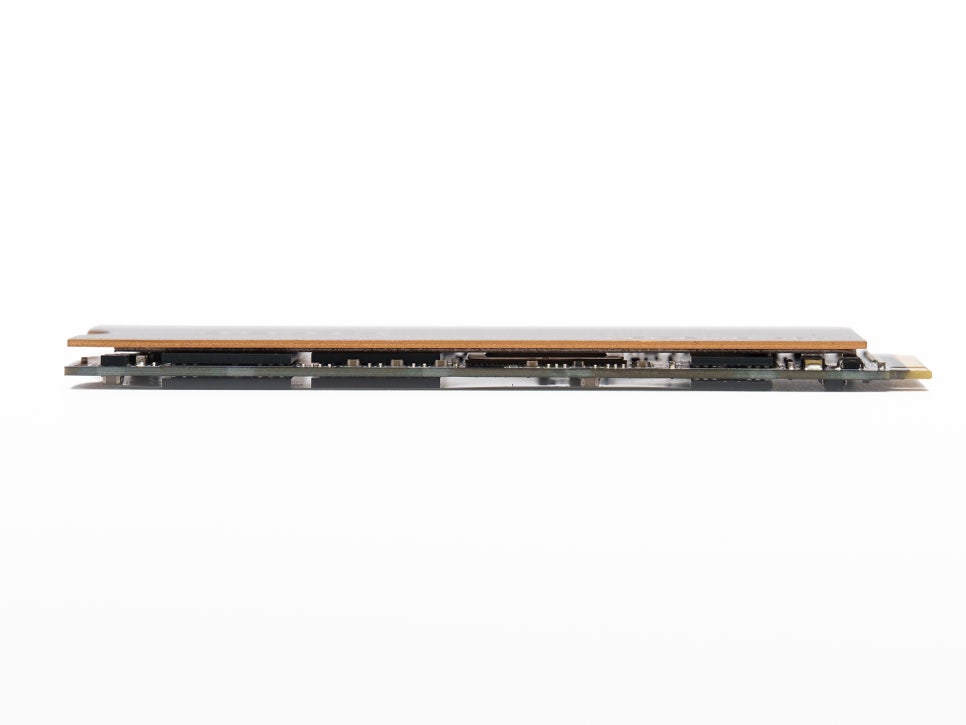
The total thickness, including the heatsink, is 4.68mm, allowing for installation and operation in the PS5 expansion slot. The weight is approximately 11g with the heatsink and only about 8g without it. Furthermore, ADATA’s SSD Toolbox software allows you to conveniently monitor drive status, check S.M.A.R.T. information, update firmware, perform secure erase, and more.
Performance Test
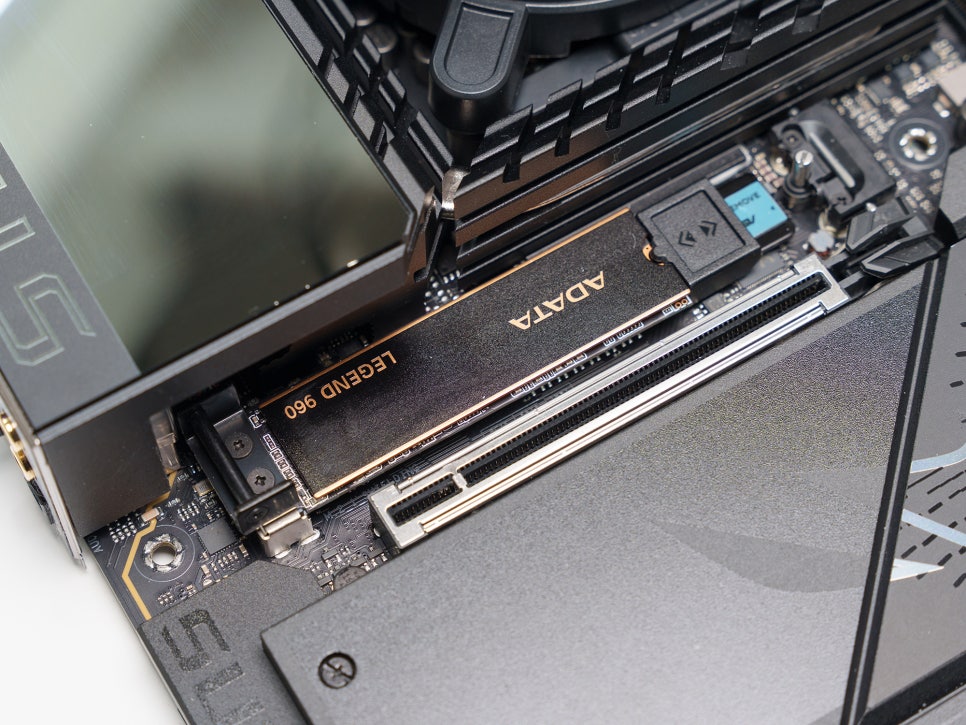
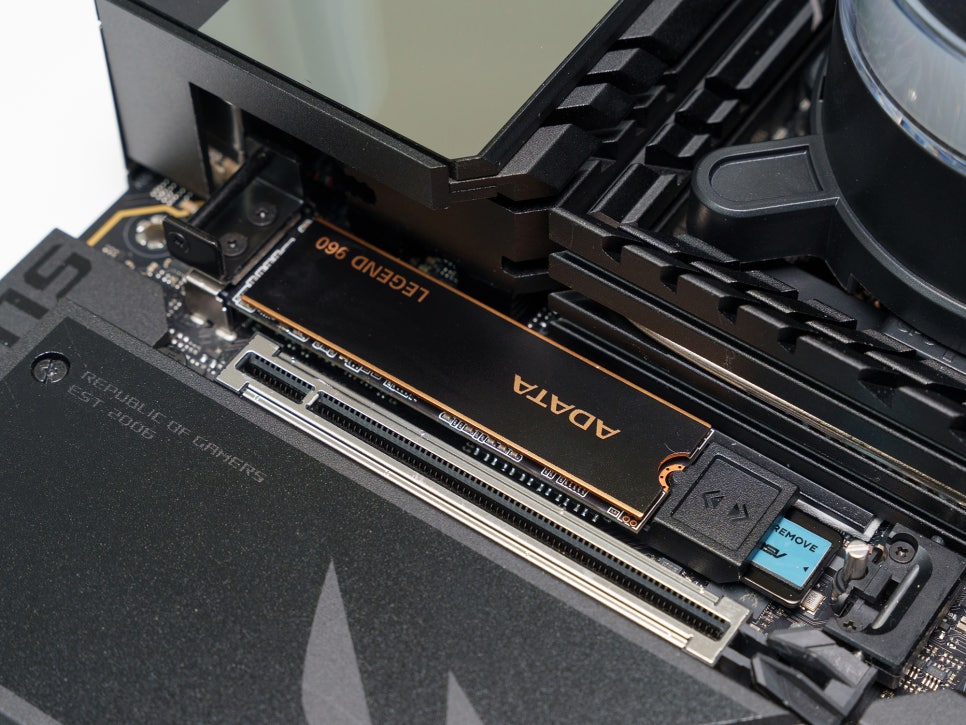
We tested the performance of the ADATA LEGEND 960 M.2 NVMe FineInfo 1TB through actual benchmarks, and the system used is as follows:
System Specifications
CPU : AMD Ryzen 7 9800X3D
Motherboard : ASUS TUF Gaming B850M-Plus WiFi
Graphics Card : NVIDIA GeForce RTX 2080TI
Memory : ESSENCORE KLEVV DDR5-6400 CL32D URBANE V RGB 32GB
CrystalDiskMark
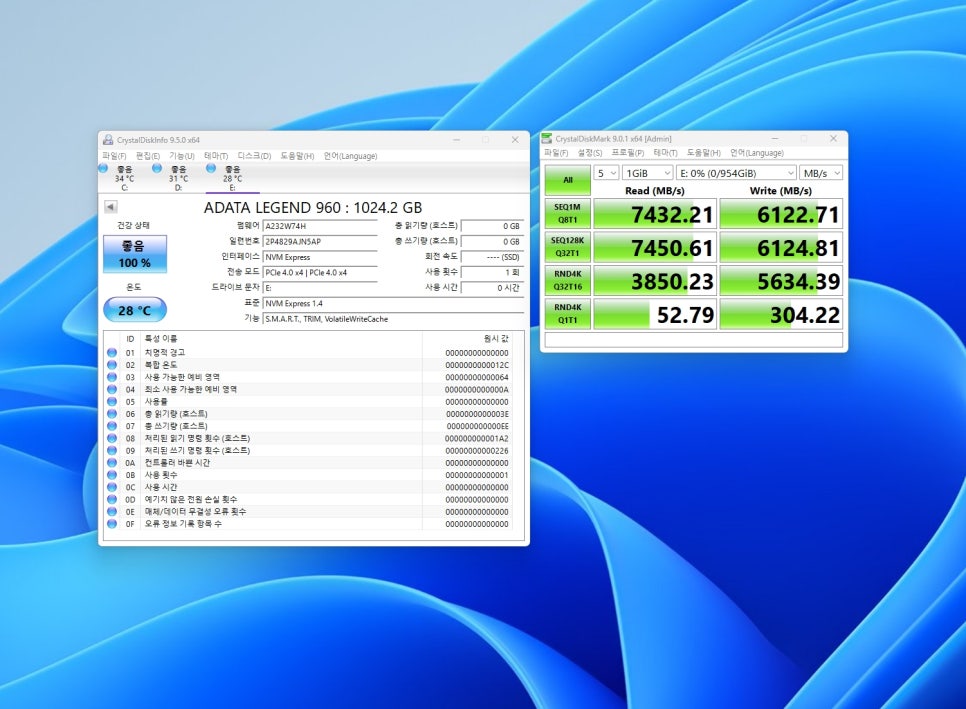
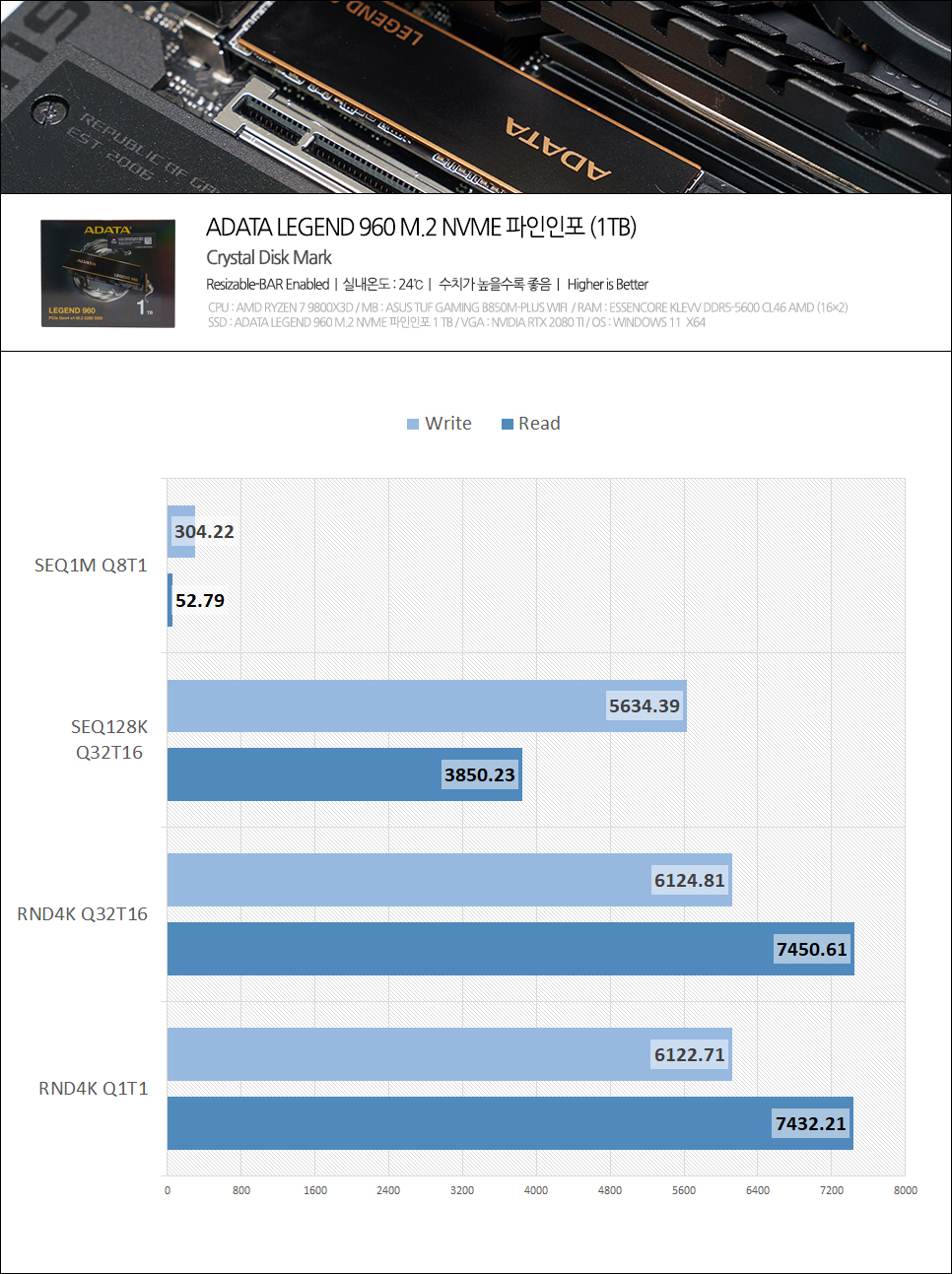
According to the CrystalDiskMark test results, the LEGEND 960 1TB recorded a sequential read speed of approximately 7,400MB/s, closely approaching its nominal specifications. Sequential write speeds also showed results close to approximately 6,400MB/s. Its 4K random performance was also excellent; notably, as the queue depth increased, the effect of the DRAM cache became more pronounced, maintaining stable IOPS.
AS SSD Benchmark
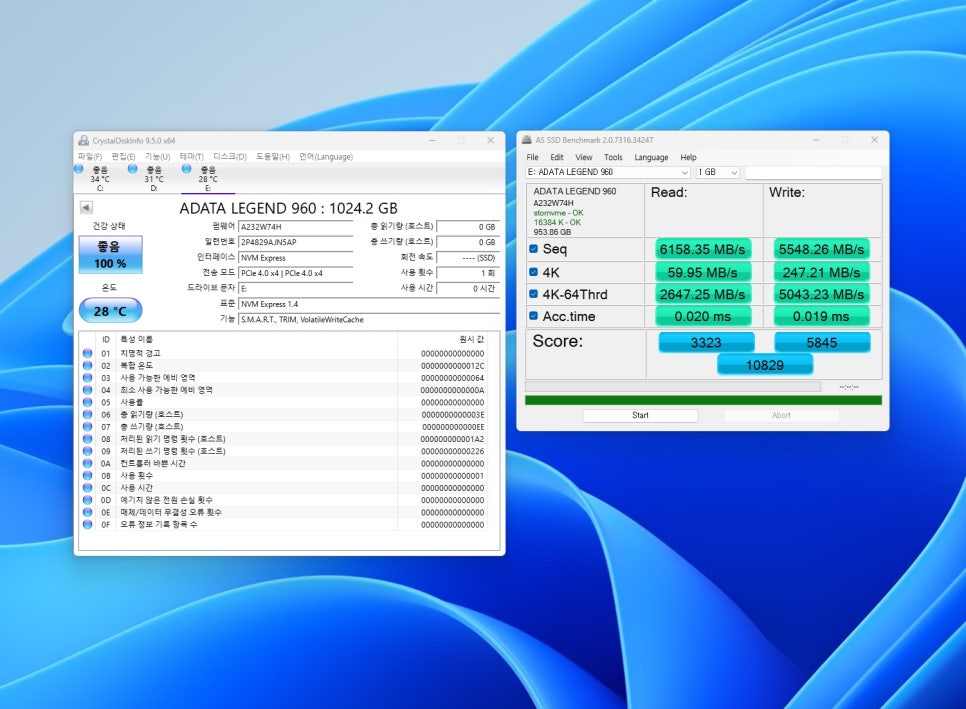
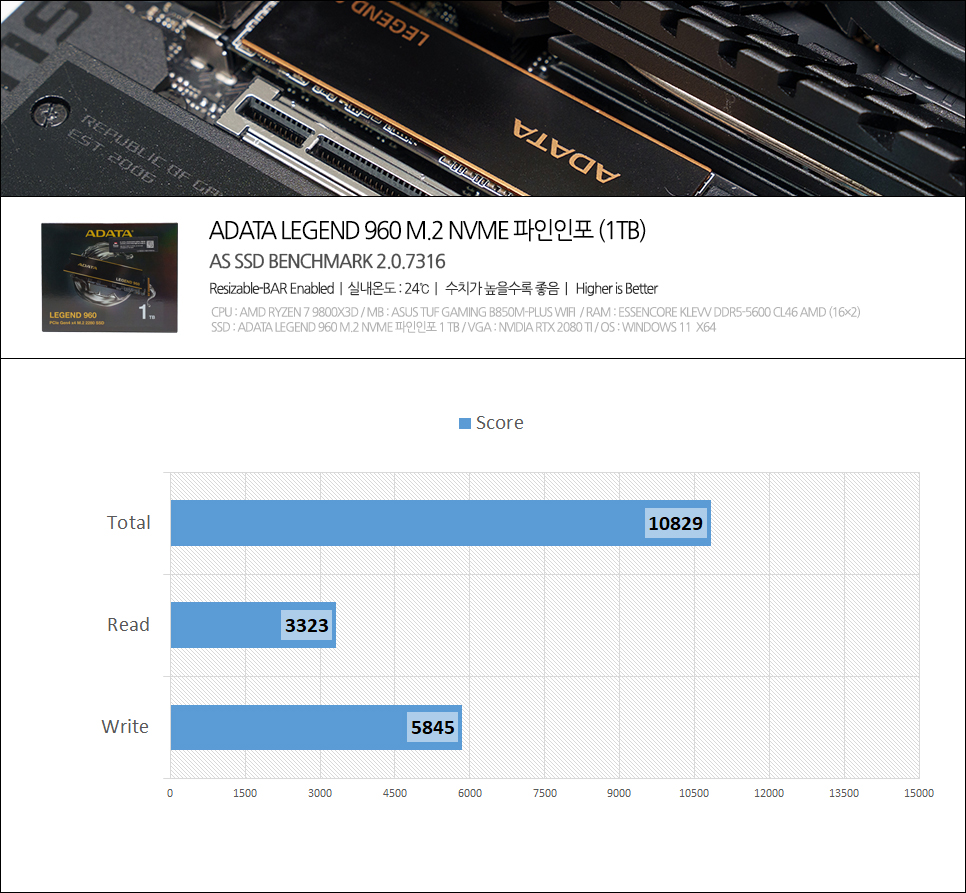
AS SSD Benchmark is similar to CrystalDiskMark, but because it tests using uncompressed data, it is a tool that more accurately reflects the actual NAND performance of an SSD. In particular, its scoring system facilitates easy comparison between products. The LEGEND 960 1TB recorded high bandwidth for both sequential read and write in AS SSD, and also showed stable figures for 4K random performance and access time.
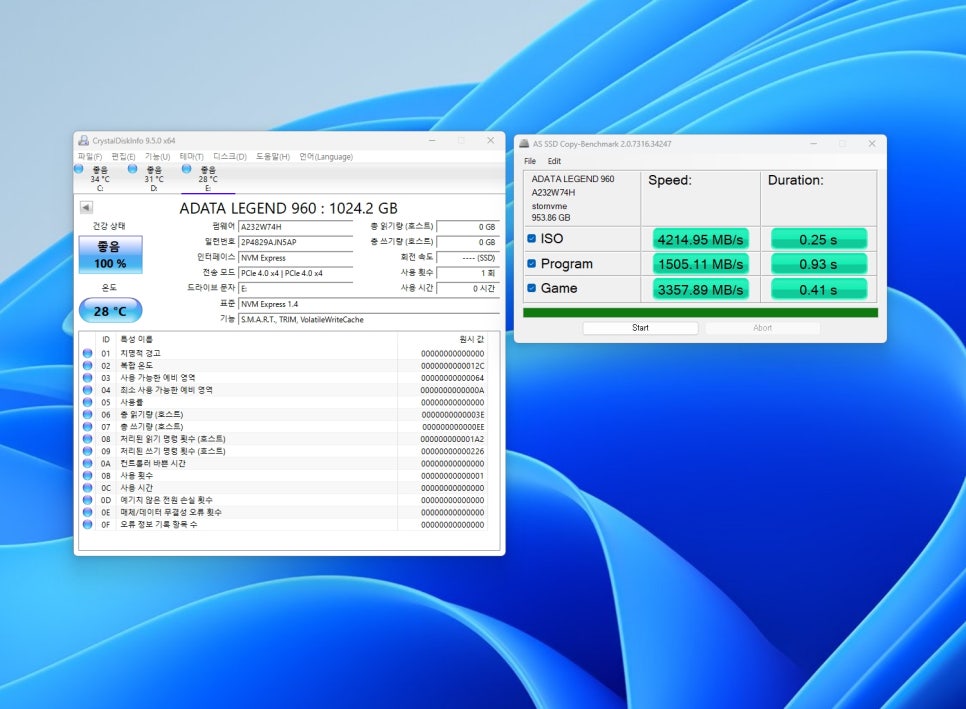
AS SSD Copy-Benchmark simulates real-world file copy scenarios, measuring copy speeds for different file types such as ISO images, program files, and game data. The test results recorded ISO at 4,214 MB/s, Program at 1,505 MB/s, and Game at 3,357 MB/s.
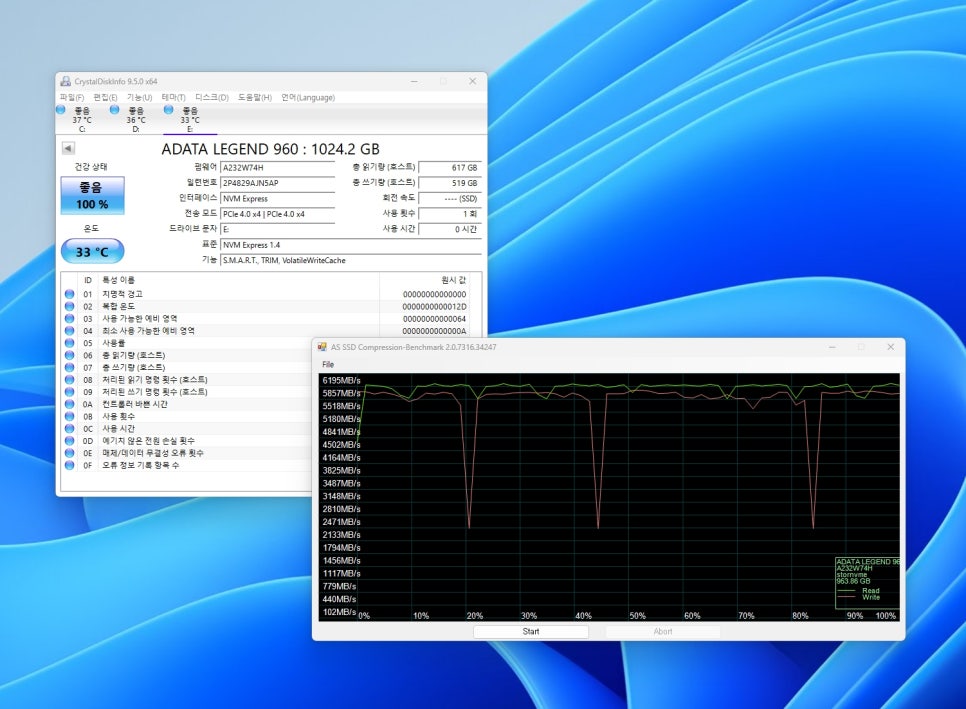
AS SSD Compression-Benchmark measures read and write speeds by continuously varying data from compressible to incompressible. Although the write section shows a graph with three fluctuations, the read speed maintained a nearly constant, flat graph.
AJA System Test
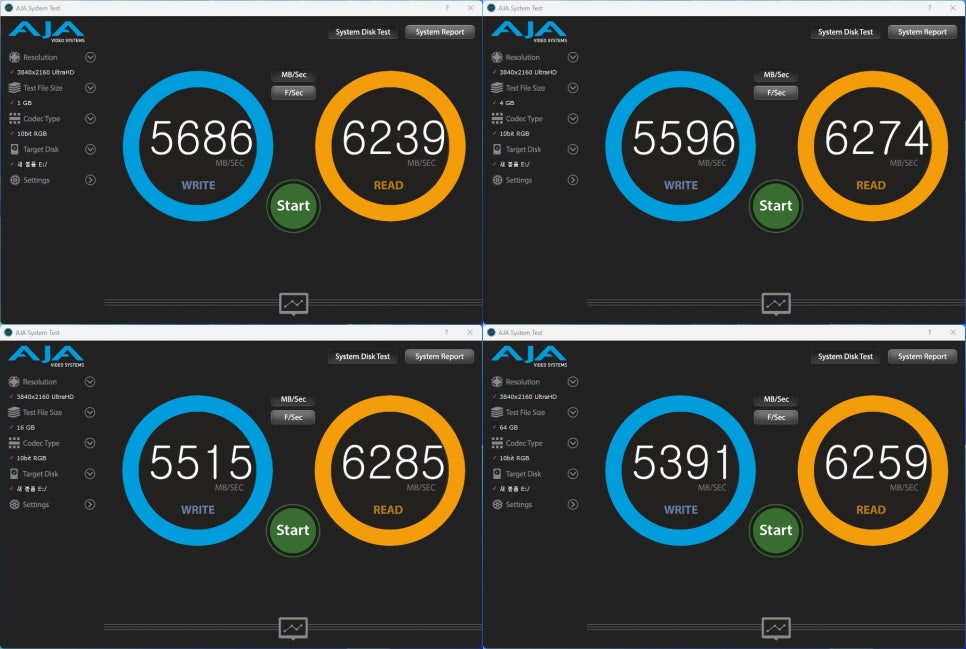
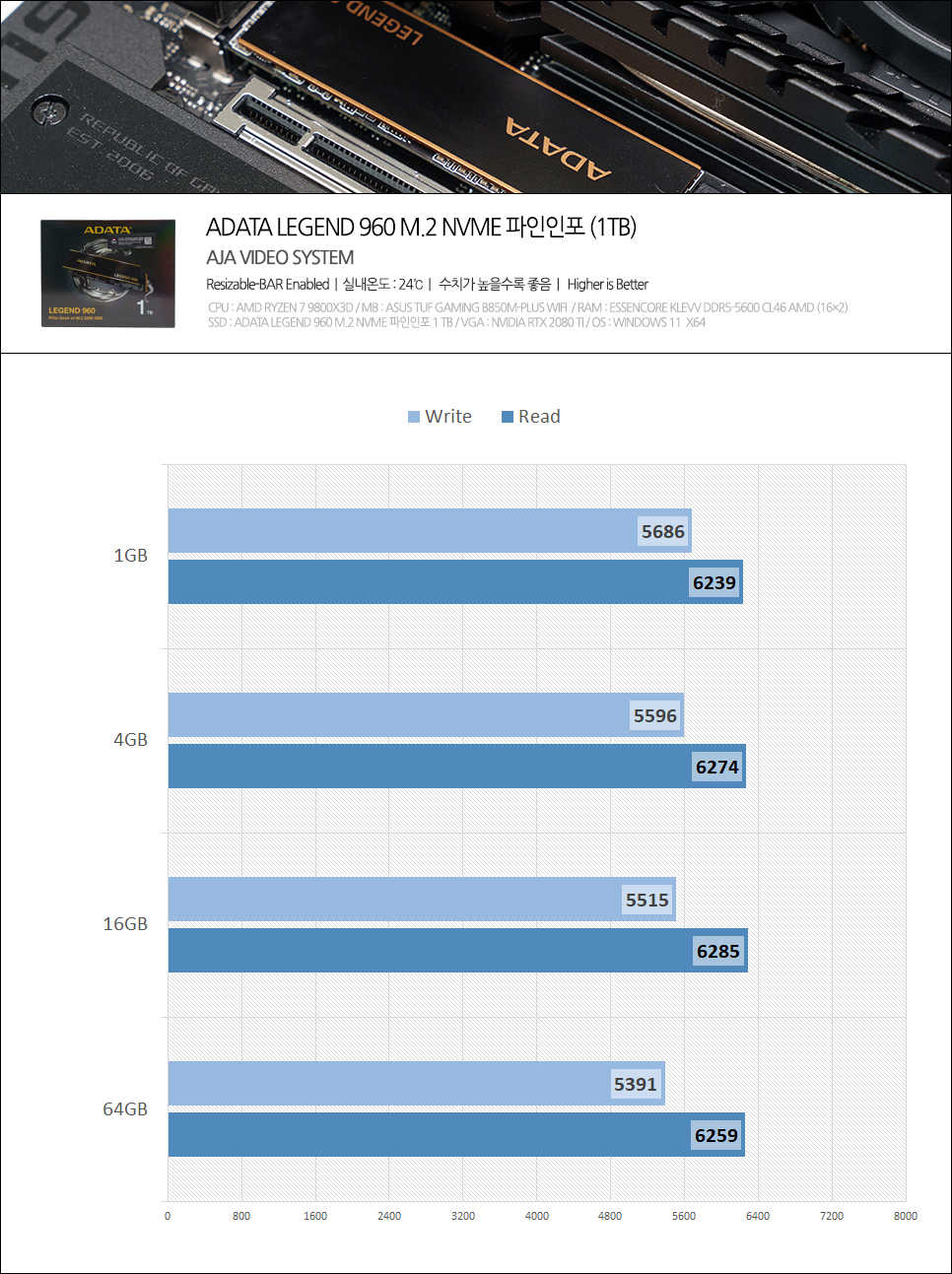
AJA System Test is a benchmark favored by video professionals, used to measure read/write bandwidth at specific resolution and codec settings to gauge practical performance in video editing workflows. The LEGEND 960 1TB recorded high read/write bandwidth even in AJA System Test, demonstrating performance that allows for smooth use without storage bottlenecks, even when editing high-resolution video sources (4K and above) in real-time.
3DMark Storage Benchmark
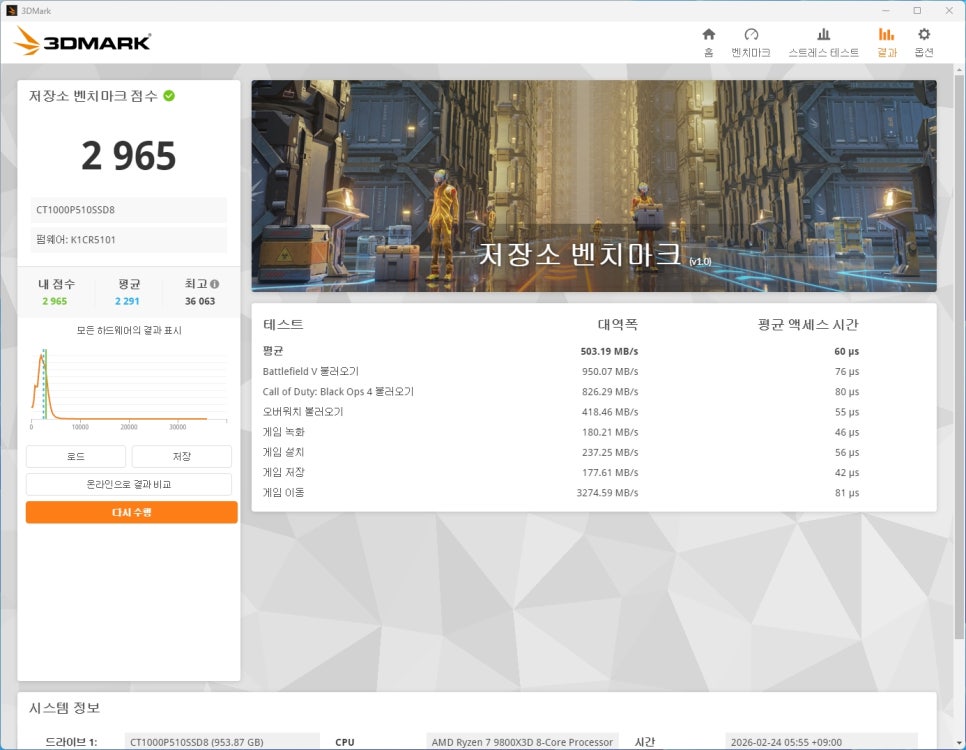
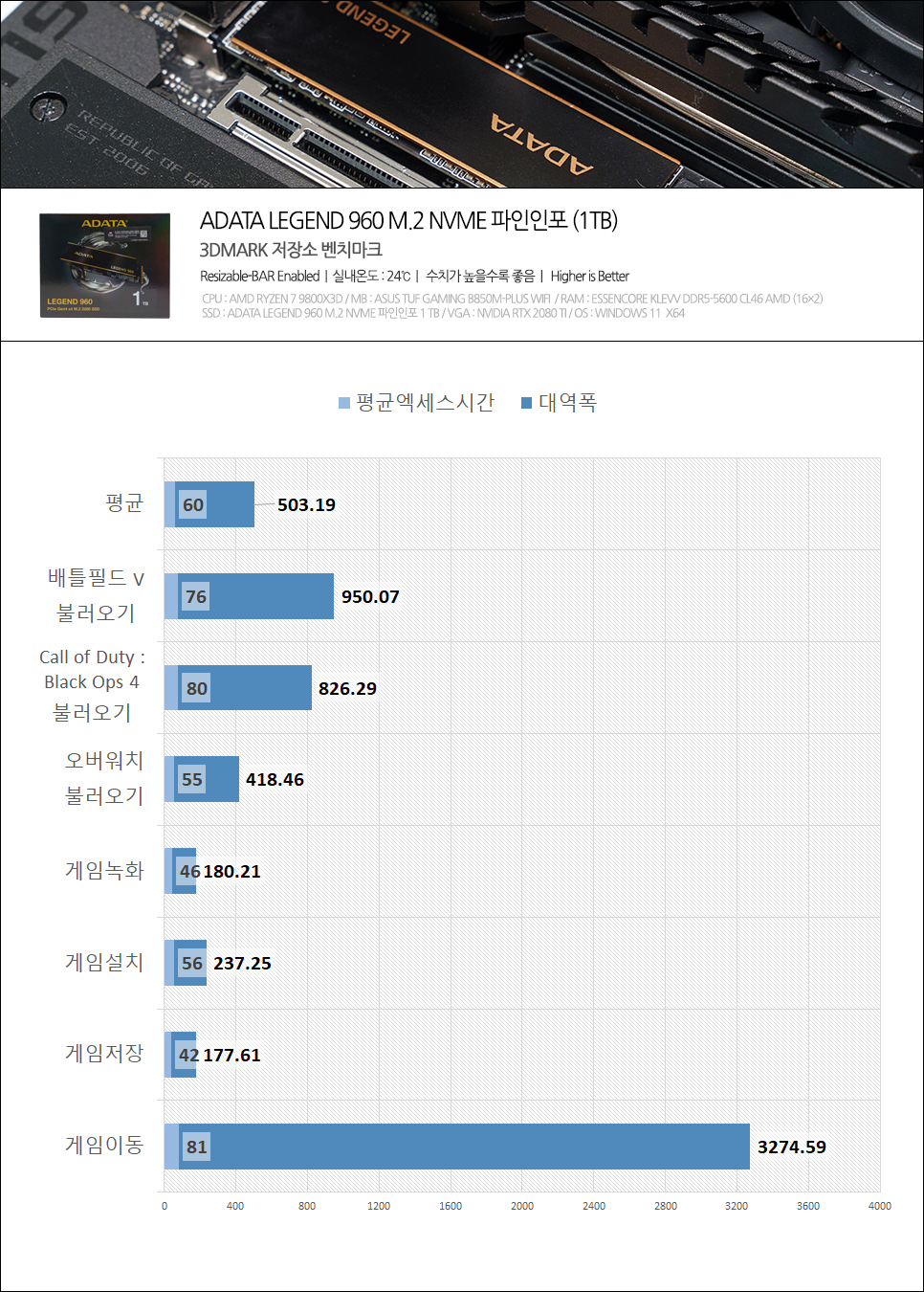
3DMark Storage Benchmark is a storage-specific benchmark developed by UL, which comprehensively evaluates various storage workload patterns that occur in actual gaming environments, such as game installation, loading, recording, and file transfers. The benchmark recorded a score of 2,965 points. This score is a top-tier result in the PCIe 4.0 NVMe SSD category, demonstrating sufficient performance for reduced game loading times and handling large-scale game data.
3DMark DirectStorage
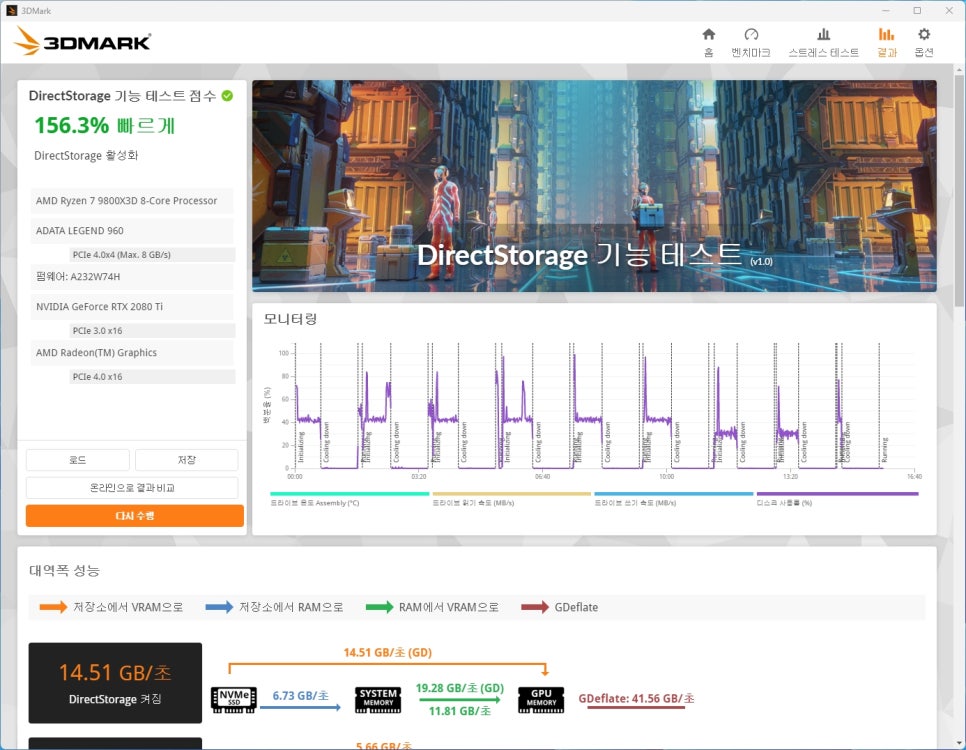
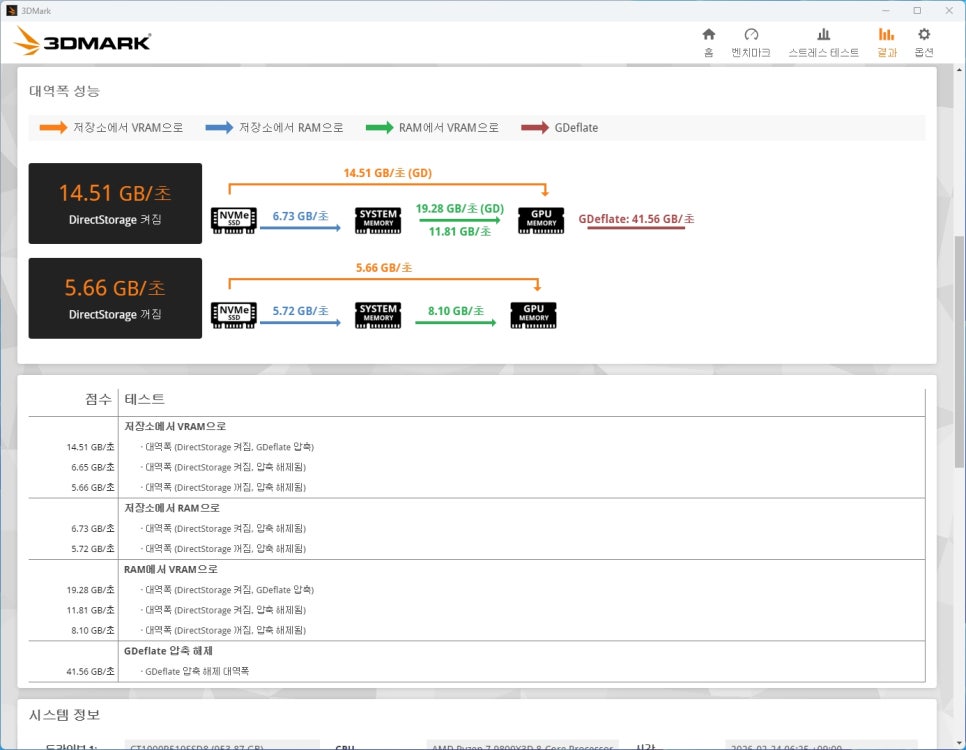
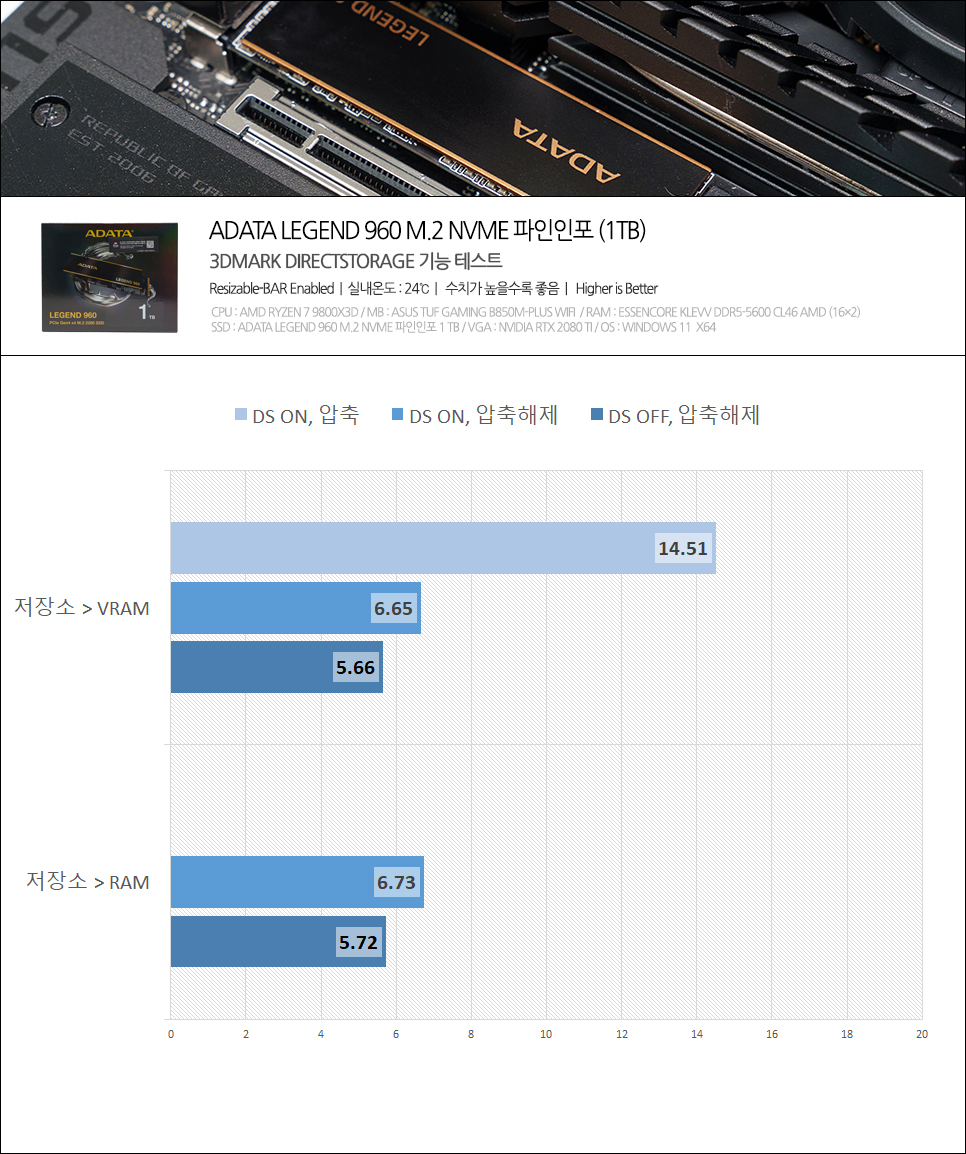
The 3DMark DirectStorage benchmark utilizes Microsoft’s DirectStorage API to measure the GPU’s performance in directly loading decompressed texture data from storage. In the 3DMark DirectStorage test, a performance improvement of 156.3% was recorded.
This allows for immersive gameplay without pop-in or stuttering, even in game environments like open worlds that require real-time loading of large map data.
Dummy File Creator
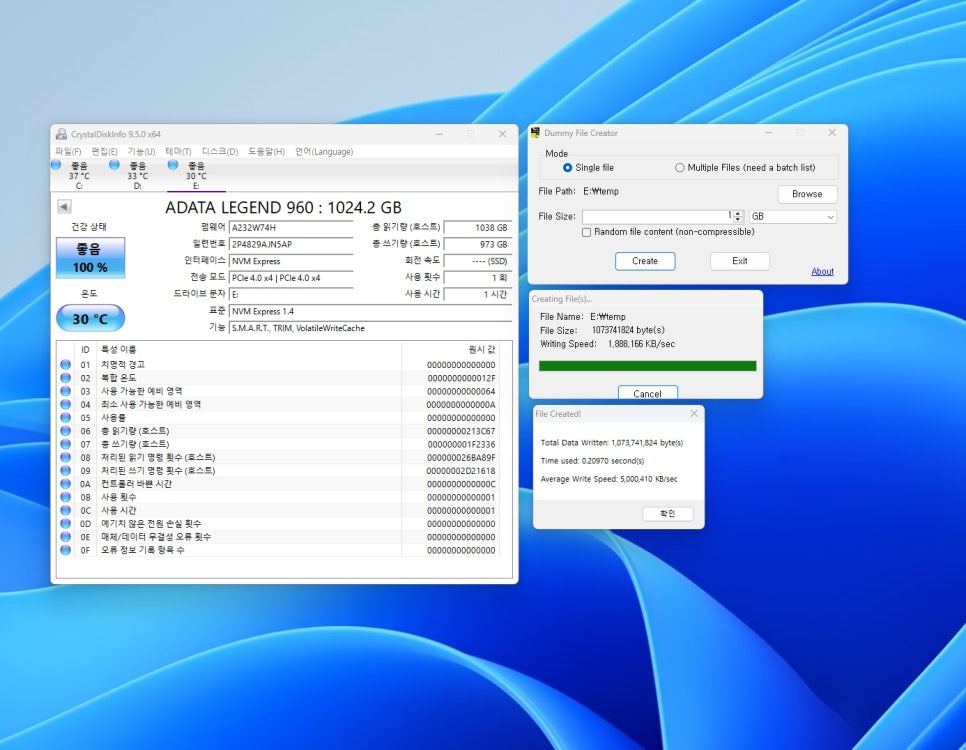
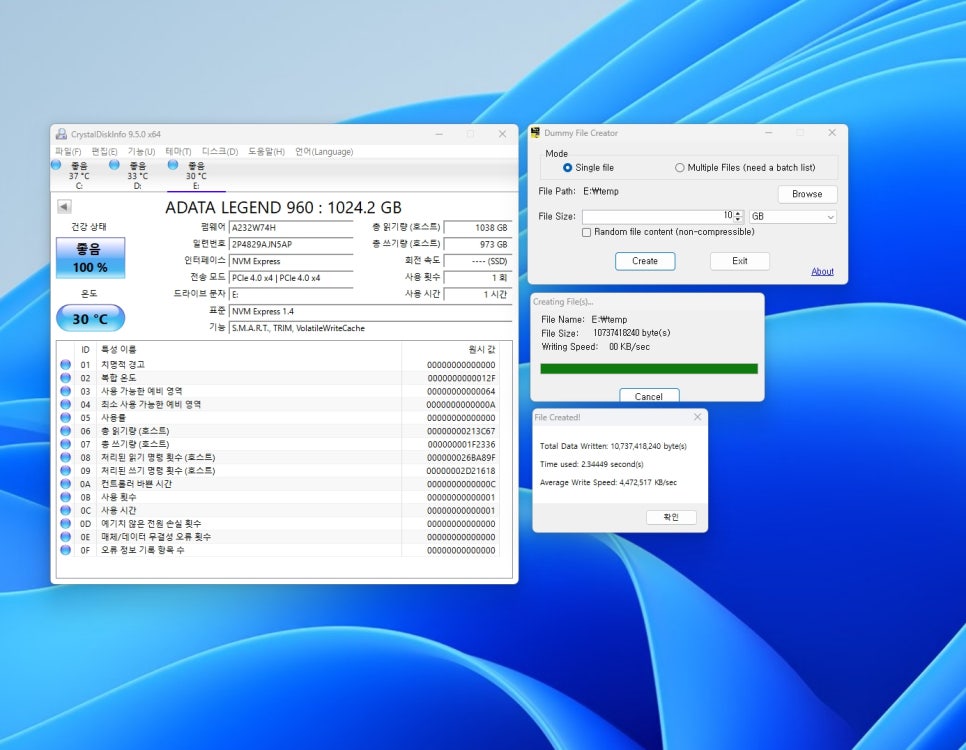
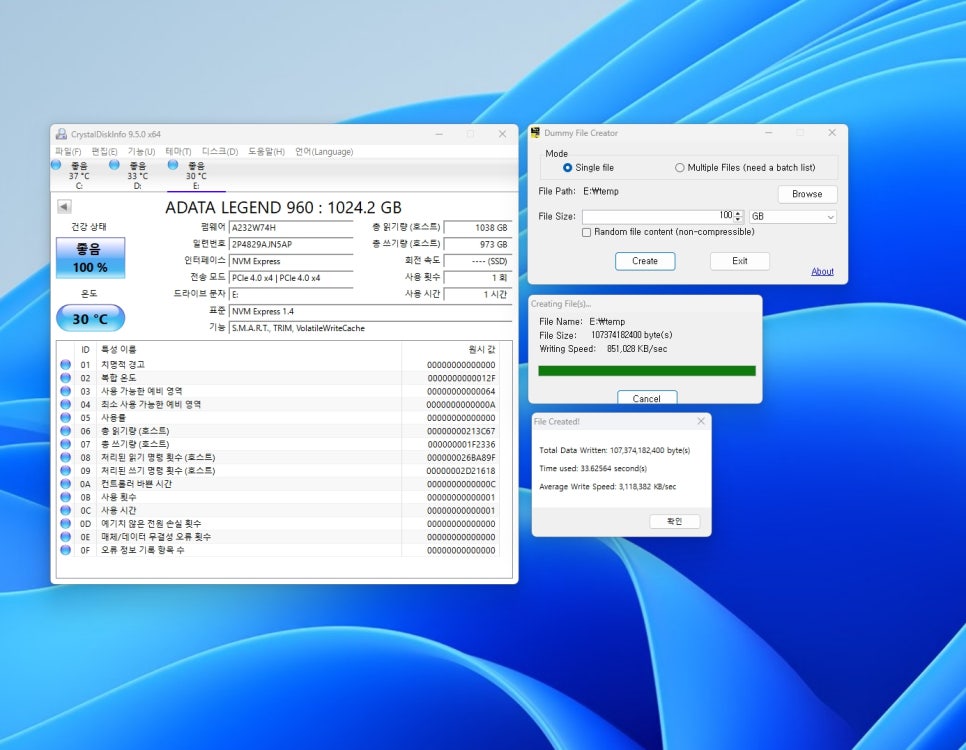
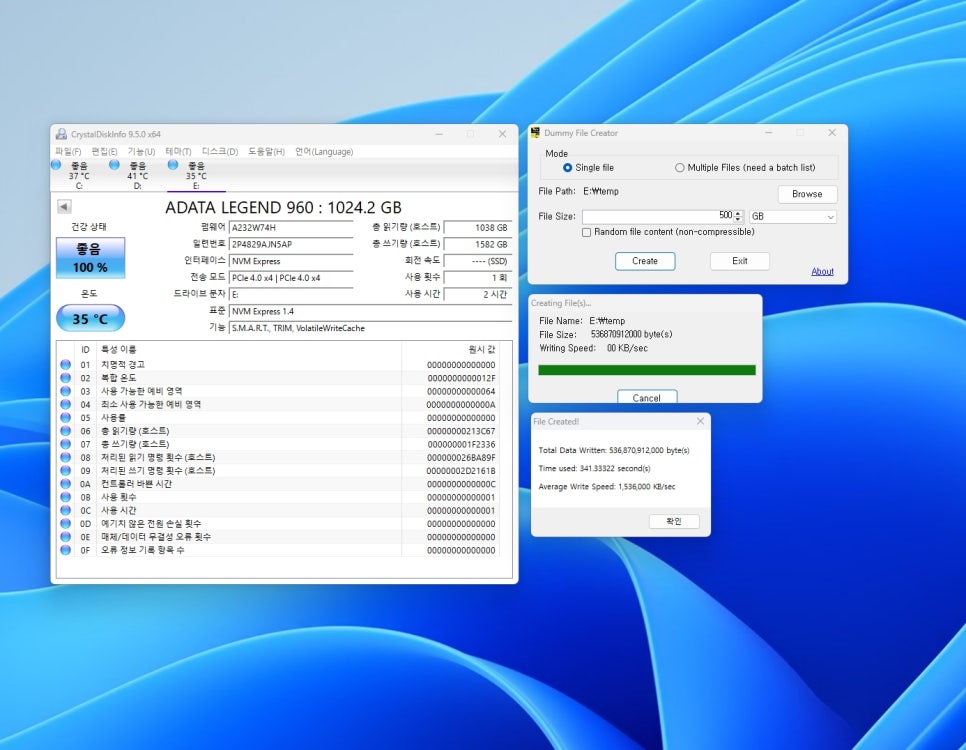
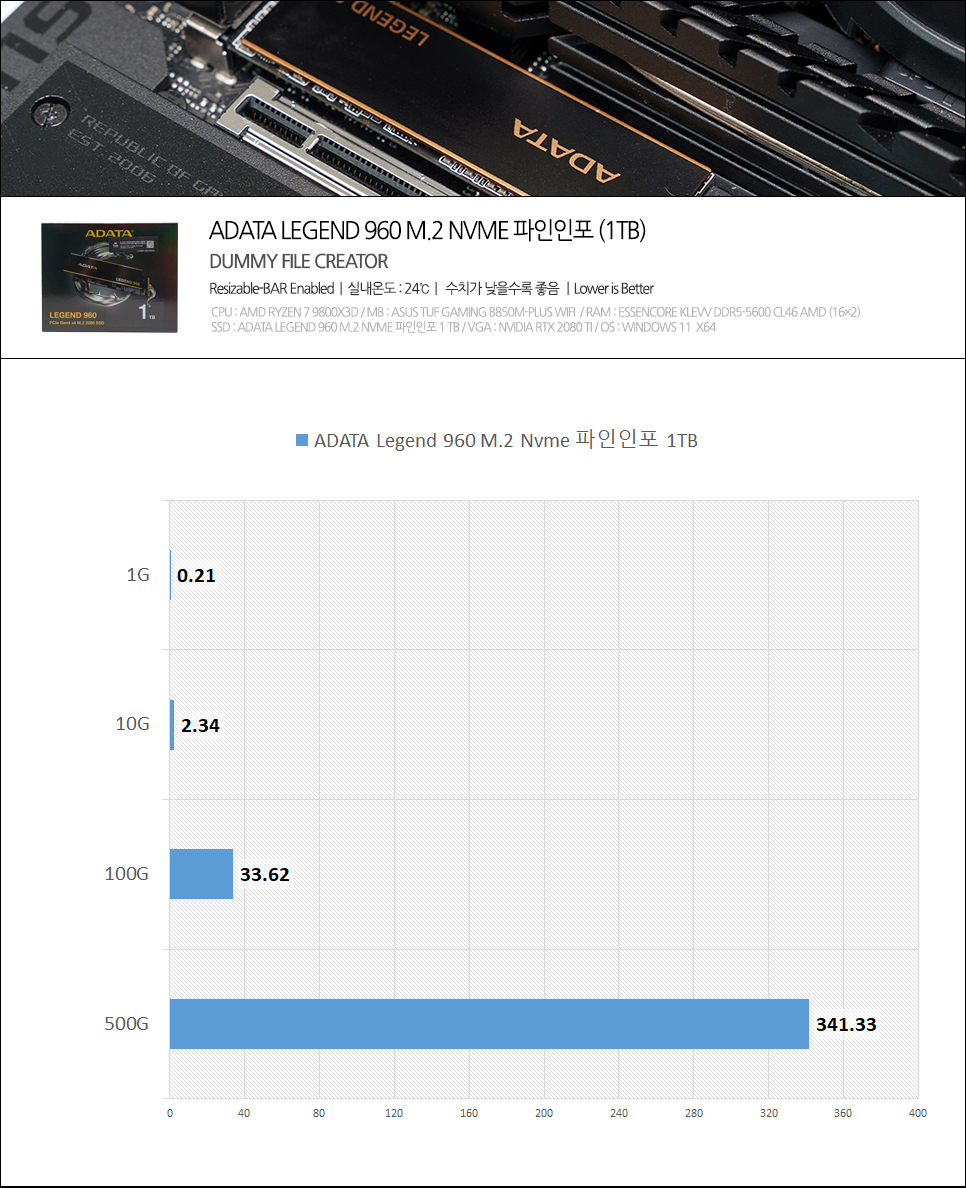
The large file creation test using Dummy File Creator generates dummy files of various sizes and measures the time taken. Test results show it took 0.21 seconds to create a 1GB file, 2.34 seconds for 10GB, 33.62 seconds for 100GB, and 341.33 seconds for 500GB. Up to 100GB, very fast write speeds were maintained within the SLC cache area. In the 500GB segment, exceeding the SLC cache capacity of the 1TB model, it switched to direct TLC writing, showing a slight decrease in speed. However, this is an extreme scenario where a file amounting to half of the total capacity of a 1TB model is written at once. In typical usage environments, it’s difficult to perceive any speed degradation thanks to the SLC cache.
Naraeon Dirty Test and Temperature Measurement
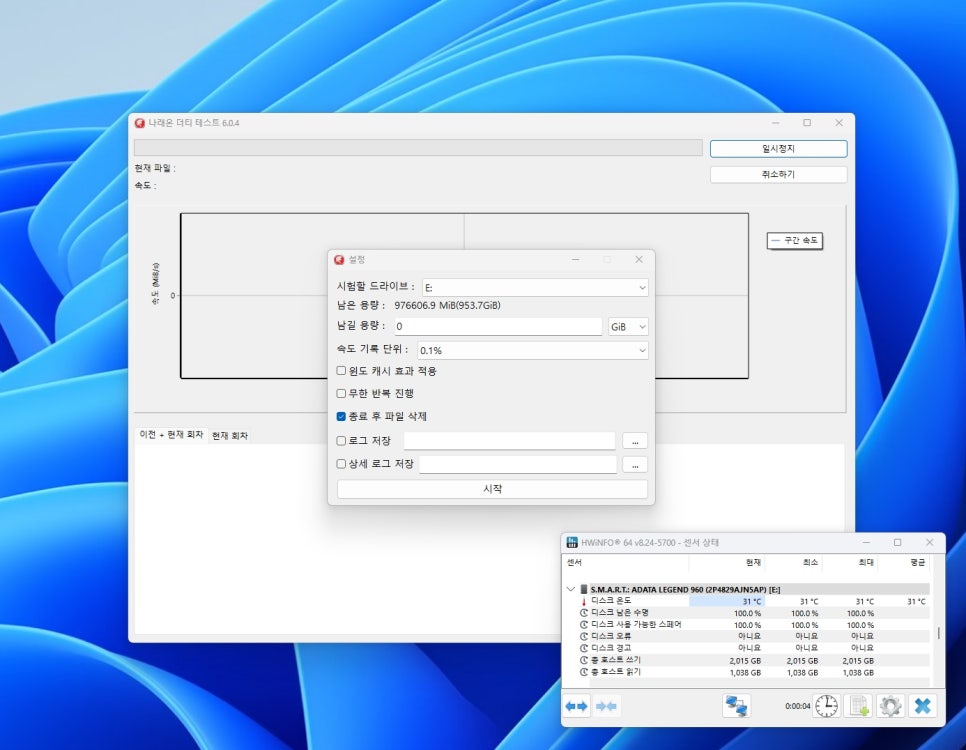
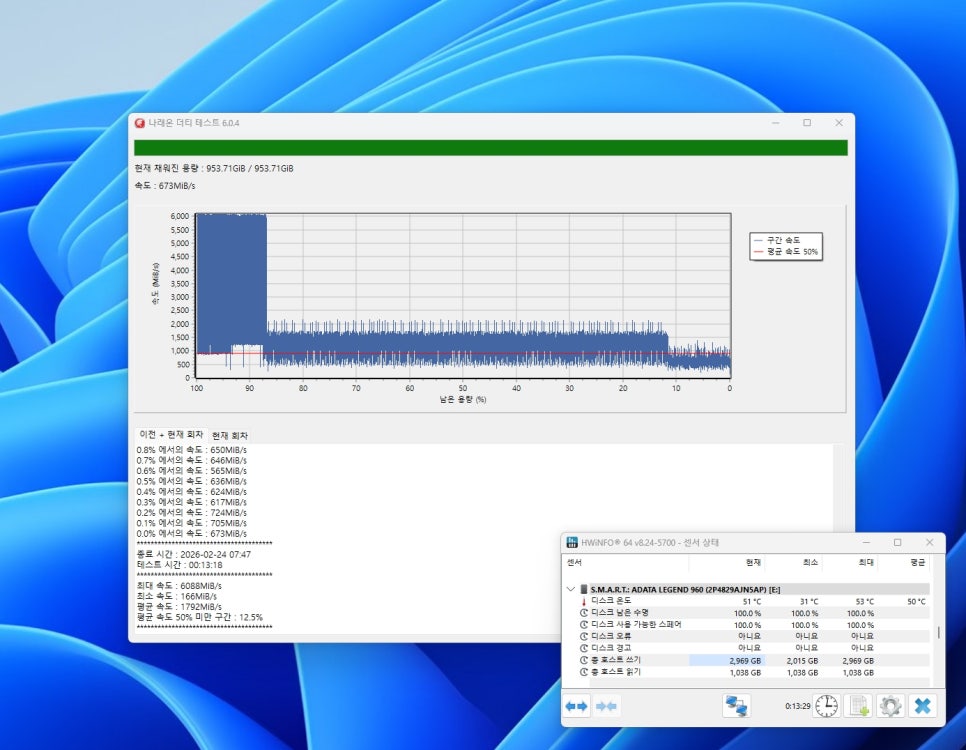
The Naraeon Dirty Test is a tool that applies a continuous write load to an SSD and observes real-time performance changes. It’s used to check performance stability and the presence of throttling during prolonged use. We conducted temperature monitoring simultaneously while running the test.
It initially shows a generous caching section of over 120GB. While there’s some speed fluctuation after the cache is exhausted, a performance drop is observed when the capacity is almost full. Of course, the performance is more than sufficient for general gaming or video editing use.
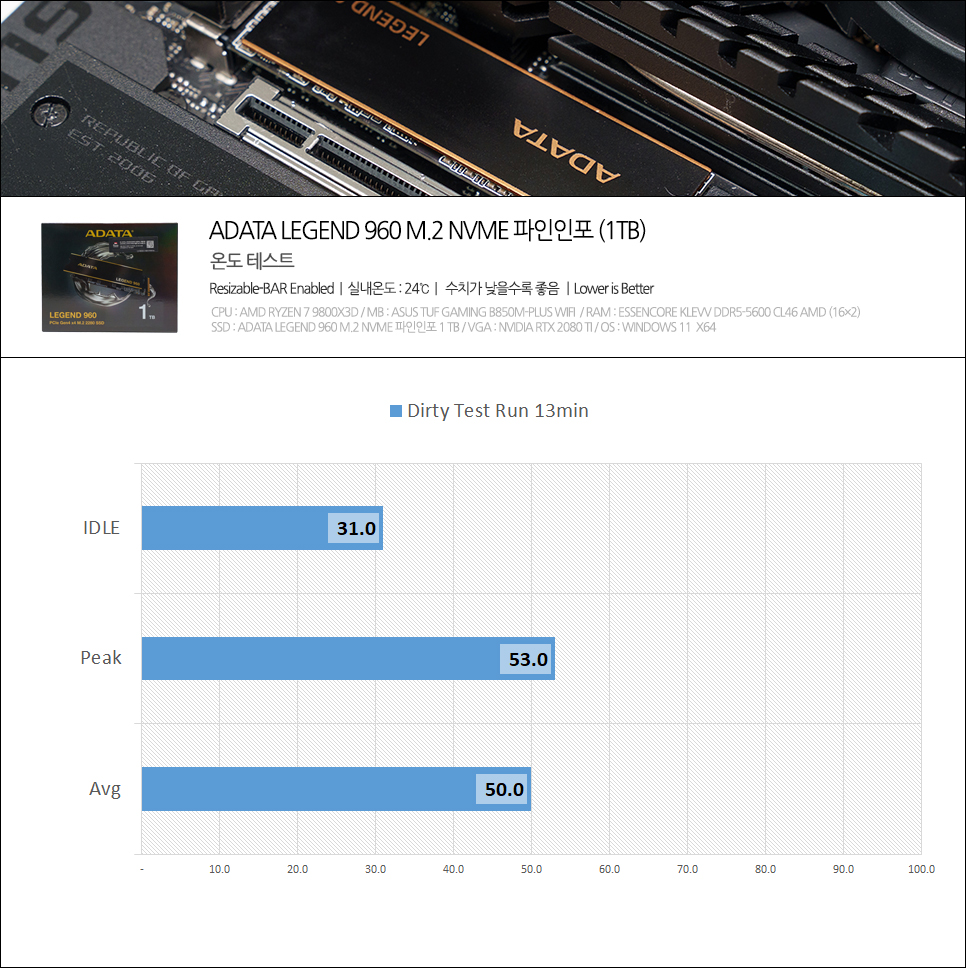
With the included heatsink installed, temperatures measured were 31°C at idle, a maximum of 53°C under load, and an average of 50°C. These figures are quite comfortable compared to the throttling threshold of 70-80°C, confirming that the included heatsink alone provides sufficient cooling.
Concluding the Review
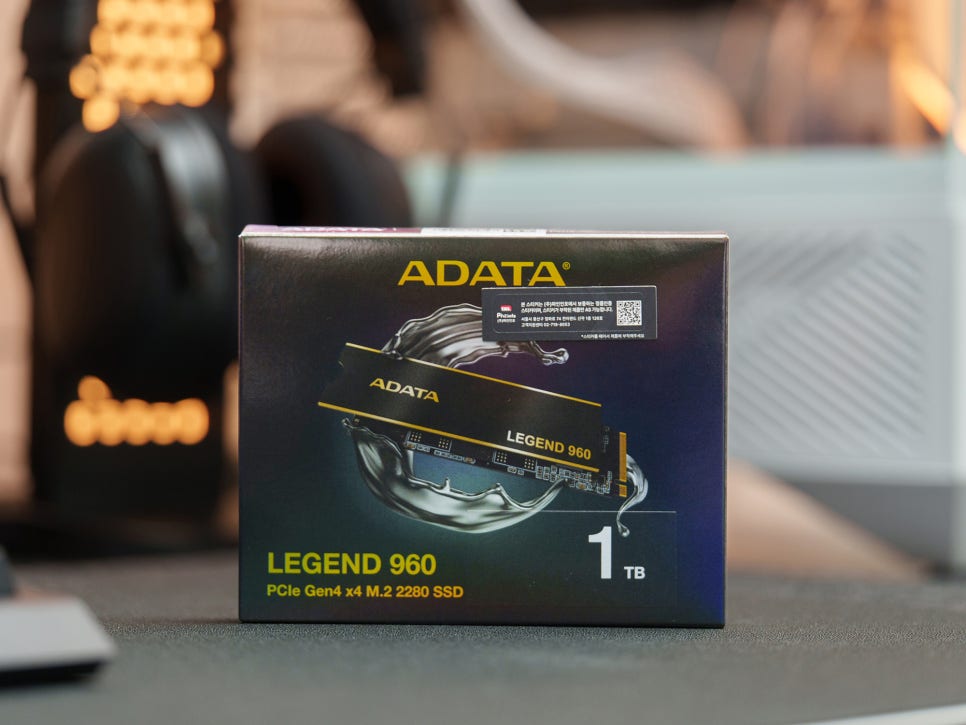
After testing the ADATA LEGEND 960 M.2 NVMe FineInfo 1TB, it appears to be a product that maximizes PCIe 4.0 generation performance through a combination of the Silicon Motion SM2264 controller, Micron 176-layer 3D TLC NAND, and Samsung DDR4 DRAM, providing 1GB per TB. Thanks to SLC caching and DRAM cache, it offers fast response times and a noticeably quicker perceived response when booting Windows or loading games. In terms of thermal management, the included black aluminum heatsink was also sufficient for temperature control.
It boasts a generous 780TB TBW, 2 million hours MTBF, and a 5-year limited warranty. What’s more, in Korea, it is distributed as a genuine product by FineInfo, an official distributor with a long track record, ensuring you can receive official after-sales warranty service. I believe this is a crucial reassurance factor when making a purchase decision.
While the era of PCIe 5.0 is dawning, at a time when the practical difference in performance for the price is not yet significant, if you’re looking to acquire a DRAM-equipped PCIe 4.0 NVMe SSD at a reasonable price, I recommend the ADATA LEGEND 960.
Buy Product
As an Amazon Associate I earn from qualifying purhases.
Purchase Product : https://amzn.to/4lYJhff